Intelligent data analytics and systems design: AI-ML-DL-VIS


TRD3 will develop and validate analytical methods, including Artificial Intelligence (AI), Machine Learning (ML), and Deep Learning (DL), for intelligent instrument design, data/image analysis, visualization, and clinical decisions.
Decisions in critical clinical scenarios (e.g., surgery, intensive care, and obstetrics) is compromised by lack of 1) real-time intraprocedural imaging and pathologic data, 2) integration of this data with other personal and universal clinical data, and 3) effective visualization interfaces. TRD3 will develop AI-ML-DL and VIS tools to address these challenges.
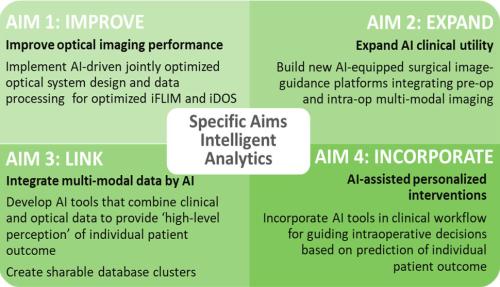
First, it will build data-driven computational instruments from the perspective of intelligent optical system design, in which the optical hardware and the back-end machine learning model are jointly optimized for a given task. Second, it will develop a new visualization and AI-equipped surgical guidance platform, fusing intra-procedural iFLIM and/or iNIRS data with pre-operative volumetric CT, MRI, and PET images. Third, it will employ intelligent analytics to evaluate the multiple streams of data from this intraprocedural imaging, the patient’s medical history and prior imaging to better characterize the patient’s disease, predict its response to options for treatment appearing both during and after the procedure, and thus guide the clinician to the most effective choice. All these tools will be incorporated into clinical workflow for intraoperative guidance.
TRD3 has four specific aims, illustrated in the image below. Aim 1 uses machine learning-enabled design to enhance performance of optical instruments. Aim 2 develops expressive visualization interfaces aiding comprehension of multi-modal image data. Aim 3 develops DL/ML/AI tools for integration of data streams. Aim 4 incorporates predictive tools into clinical workflow for augmented, individual-specific, intraprocedural decisions.