Interventional Fluorescence Lifetime Imaging (iFLIM)


TRD1 advances and integrates Interventional Fluorescence Lifetime Imaging (iFLIM) technologies for real-time, in situ tissue assessment and guidance during clinical interventions.
Clinicians currently have limited tools for assessing site-specific tissue properties in real time during interventional procedures. iFLIM addresses this unmet need by providing rapid, label-free biochemical information that complements visual, structural, and functional information and supports intraprocedural decision-making across a broad range of clinical applications. Although the fundamental principles of fluorescence lifetime imaging (FLIM) are well established and FLIM technologies are widely used in biomedical research, their translation to clinical interventions remains limited, and their full clinical potential has yet to be realized. TRD1 seeks to bridge this gap by developing iFLIM technologies that are faster, more sensitive, scalable, and readily integrated into clinical workflows.
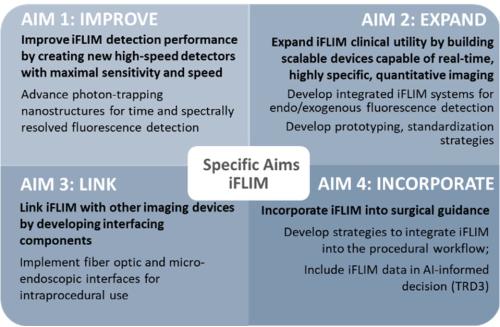
TRD1 is organized around four Specific Aims, illustrated below. Aim 1 advances the performance and scalability of iFLIM technology. Aim 2 expands the clinical utility and molecular specificity of iFLIM by extending fluorescence lifetime contrast beyond endogenous, label-free contrast through the use of molecular probes, enabling detection and characterization of disease-specific molecular processes, while advancing prototyping and standardization to facilitate broader clinical translation. Aim 3 focuses on the synergistic integration of iFLIM with complementary optical imaging modalities to provide more comprehensive tissue characterization. Aim 4 advances integration into intraprocedural workflows and establishes well-curated clinical imaging databases to support technology validation, data analytics, and clinical implementation.